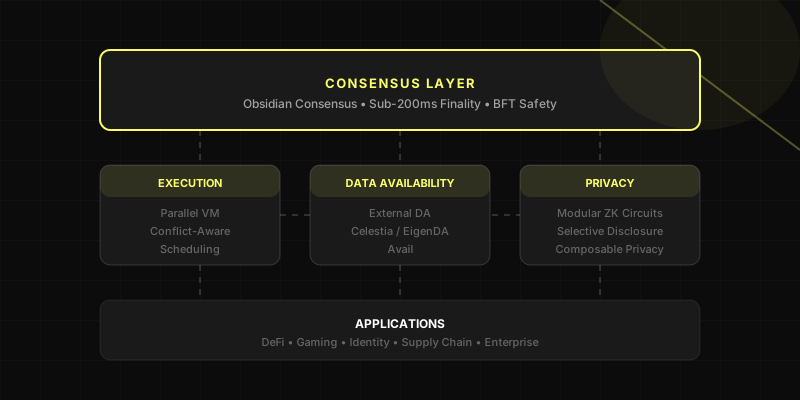
The Obsidian DEX infrastructure advantage
Obsidian Finance operates as a smart aggregation layer, not merely another decentralized exchange. Its core function is to identify the best trading rates by querying multiple liquidity sources simultaneously. This infrastructure approach creates a competitive moat that separates high-performance trading from simple token speculation. By prioritizing the underlying mechanics of trade execution, Obsidian addresses the fragmentation that plagues the DeFi space.
How Smart Aggregation Works
When you trade on Obsidian, the protocol doesn't rely on a single liquidity pool. Instead, it acts as an intelligent router, scanning various decentralized exchanges to find the most efficient path for your swap. This process minimizes slippage and maximizes the amount of assets you receive. The system is designed to handle complex multi-hop trades automatically, ensuring you get the best possible rate without manual intervention. This efficiency is the foundation of any viable trading strategy on the platform.
Why Infrastructure Matters for Alpha
In a market where volatility is constant, the quality of your execution infrastructure determines your edge. Obsidian’s focus on aggregation logic ensures that traders are not penalized by poor routing or fragmented liquidity. This technical advantage allows users to maintain tighter spreads and faster execution times, which are critical for capturing alpha in fast-moving markets. The platform’s security and reliability are built on these robust aggregation protocols, providing a stable environment for high-stakes financial decisions.
Routing logic for best execution
In decentralized finance, a quoted price is often just a starting point. The real alpha comes from how the trade actually settles. Obsidian’s infrastructure treats routing not as a simple swap, but as a complex logistical problem. By querying multiple decentralized exchanges simultaneously, the system identifies the most efficient path for your capital.
This approach minimizes slippage by breaking large orders into smaller fragments. Instead of dumping a massive buy order into a single pool and driving the price up, Obsidian splits the execution across various liquidity sources. The result is a tighter average entry price and less market impact.
To see the difference between direct swapping and smart aggregation, consider the following comparison of execution paths for a standard trading pair:
| Feature | Direct Swap | Obsidian Smart Aggregation |
|---|---|---|
| Liquidity Source | Single Pool | Multiple Pools |
| Slippage Impact | High | Minimal |
| Price Discovery | Static | Dynamic |
| Execution Speed | Fast | Optimized |
The table above highlights why infrastructure is the competitive moat. While other platforms might offer a quick quote, Obsidian ensures that the quote remains valid through intelligent splitting. This is particularly critical in volatile markets where liquidity can vanish in seconds.
For a visual representation of the asset performance that benefits from this precise routing, you can track the underlying token metrics:
This level of granularity transforms trading from a game of luck into a calculation of efficiency. By leveraging official aggregation logic, Obsidian ensures that every basis point counts.
Managing Volatility with Smart Limits
Market swings in decentralized finance can quickly turn a promising position into a slippage nightmare. Relying solely on market orders during high-volatility periods often means accepting unfavorable execution prices. Obsidian’s infrastructure addresses this by integrating dynamic pricing logic that adapts to real-time liquidity conditions, allowing traders to set precise entry and exit points without manually monitoring every tick.
The core advantage lies in Obsidian’s smart aggregator system. Instead of routing trades through a single liquidity pool, the protocol queries multiple decentralized exchanges simultaneously to identify the best available rates. This aggregation reduces the impact of sudden price drops or spikes, ensuring that limit orders are filled at the most efficient price across the fragmented DEX landscape. By leveraging this multi-source liquidity, traders can maintain control over their execution costs even when the market is turbulent.
To demonstrate current market conditions, here is the live price data for the target asset:
Using limit orders effectively requires understanding how Obsidian handles partial fills and order book depth. The platform’s interface allows users to set price ceilings and floors that automatically trigger when market conditions align with their strategy. This proactive approach prevents emotional trading decisions during rapid price movements, turning volatility from a risk into a structured opportunity for alpha generation.
Risk Controls for High-Stakes DeFi
In decentralized finance, infrastructure is the moat, not just the token price. Obsidian’s smart aggregator system is designed to identify the best trading rates by querying multiple decentralized exchanges (DEXs) and selecting the most favorable paths. This aggregation logic reduces slippage, but it also introduces complex dependencies. When you route capital through multiple protocols, you are effectively borrowing the security assumptions of each link in the chain.
The primary risk in this model is smart contract vulnerability. A single exploit in a lower-tier liquidity pool can drain the aggregated route, regardless of how efficient the price discovery is. Before deploying capital, you must verify the audit status of every underlying protocol. Relying on a single audit report is insufficient; look for multi-layered verification from reputable firms and check for active bug bounty programs. If the infrastructure lacks transparent, up-to-date security credentials, the alpha is not worth the exposure.
Liquidity fragmentation is the second major threat. Obsidian’s strength lies in its ability to source depth from various pools, but deep pools can vanish quickly during high volatility. If the underlying liquidity dries up, your trade may execute at a significantly worse rate or fail entirely. Always monitor real-time depth charts and set strict slippage tolerances. Treat the aggregator as a tool that requires constant supervision, not a set-and-forget solution.

2026 Outlook for Obsidian DEX
The infrastructure focus remains the primary driver for Obsidian Finance. Rather than chasing speculative token pumps, the platform prioritizes its smart aggregator logic. By querying multiple decentralized exchanges to secure the best rates, it builds a durable competitive moat against other aggregators.
This approach shifts the value proposition from short-term yield farming to reliable execution. As DeFi landscapes evolve, infrastructure that guarantees optimal slippage and liquidity depth becomes the true differentiator. Investors and traders are increasingly looking for stability in execution rather than just asset appreciation.
While broader market volatility persists, the underlying utility of Obsidian’s aggregation engine offers a hedge against fragmented liquidity. The strategy adapts by reinforcing security and speed, ensuring that the platform remains relevant as the DeFi ecosystem matures into a more institutionalized space.
No comments yet. Be the first to share your thoughts!